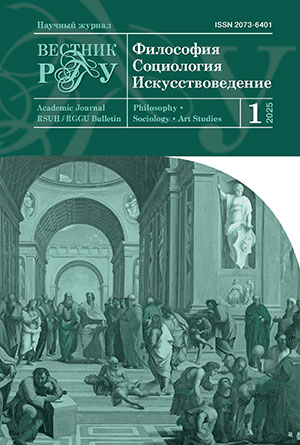
RSUH/RGGU BULLETIN. Series Philosophy. Social Studies. Art Studies – is a scientific peer-reviewed periodical, concerned with the newest scientific problems in the humanities. The journal offers research of methodological mean and importance, discovering new perspectives for scientific work in these areas.
The main topics of the journal:
- Fundamental issues of philosophy as a research of human existence and as the methodology of scientific knowledge;
- The dynamics of philosophical development in the past and in the present: current history of philosophy;
- Contemporary philosophical disciplines and the ways of their optimal integration;
- Interaction and mutual influence of theoretical and applied sociology;
- Social structures and borders of the social differences in contemporary world;
- Experiment and innovation in sociology;
- The History of arts as a key to the history of culture;
- Integration of research methods of classic and contemporary art;
- Interdisciplinary approaches to the studies in the theory and history of art;
- Sociology of science and arts as an integral academic methodology;
- The history of philosophy, sociology, and art as a history of cases and personalities;
- The perspectives of studies in theoretical humanities;
- The journal has 4 issues per year. Every issue contains from 12 to 20 original articles which feature completed academic researches passed necessary examination.
Priority in the selection of articles:
- Validity of used theoretical and methodological approaches;
- Introduction of new materials including new ways of data collection and representation;
- Deliberation and perfection of argumentation free of banality and inappropriately generalized assertions.
Precision and certainty of all data and references.
High quality of language relevant to contemporary argumentative and stylistic standards of compact representation of original academic research.
Current issue
PHILOSOPHY. HISTORY OF PHILOSOPHY
This article is devoted to the transformation of the phenomenological method in contemporary post-metaphysical theology. It traces the path from Husserl’s transcendental reduction through Heidegger’s ontological difference and Marion’s donological reduction to the radical strategies of thinking about the divine in the works of J.-L. Marion, J.D. Caputo, R. Kearney, and J.P. Manoussakis. We analyze their approaches to the problem of reduction and demonstrate how the shared legacy of Husserl and Heidegger leads these thinkers to different strategies for thinking about the divine. Caputo develops a “hauntological reduction” that transforms the existence of God into a spectral event and affirms a “weak theology” of pure expectation. Kearney and Manoussakis, in contrast, propose a prosopic (eschatological) reduction that returns philosophy to the face of the Other as the site of a concrete encounter with transcendence. It is shown that in these projects, reduction ceases to be a procedure of “subtracting” the everyday world for the sake of access to a transcendental subject or the fundamental structures of being, transforming into a method of deep attention to concrete, carnal, often marginal phenomena in which traces of the Other are revealed. We argue that the transformations of phenomenological reduction in contemporary religious thought signifies the search for a non-metaphysical language for describing religious experience, as well as to the return to philosophy of the fullness of its carnal, aesthetic, ethical, and eschatological dimensions. The article demonstrates that the discussion of method in post-metaphysical theology determines our understanding of divine being, our responsibility to the Other, and the very task of thinking “after God”.
The article examines the problematics of time and history in Husserl’s genetic phenomenology. By challenging Heidegger’s thesis that the historicity of thinking remained completely alien to Husserl’s phenomenology, and that Husserl’s position on history is exhausted by his critique of historicism in his seminal article “Philosophy as a Rigorous Science”, the author demonstrates the fundamental significance of the problematic of historicity in the project of genetic phenomenology. Husserl’s transition to genetic phenomenology is presented as an attempt to bridge the gap between the analysis of the temporality of experience and a static description of the structures of subjectivity that ignores its temporal nature. The model of historical time within the context of genetic phenomenology is defined by the concepts of sedimentation and habitualization. The phenomenological ambivalence of history as a process of problematization and deproblematization of meaning is demonstrated. Based on this, the author explicates a historicized form of double bookkeeping, which represents a synthesis of phenomenological problematization and the unproblematic nature of nonphilosophical life. The structural correspondence between the interpretation of double bookkeeping in genetic phenomenology and Heidegger’s interpretation of truth and event as a unity of unconcealment and concealment is thematized. Building on this correspondence, in the concluding section of the article, the author reveals the parallelism between Husserl’s and Heidegger’s models of historical time, which includes the dilemma of genesis and event.
In my paper I examine the question in what sense logic is interpreted by M. Heidegger as the metaphysics of truth. In this regard, I show here that he initially defines logic as the science of speech. The structural element of it is an apophantic statement, which is traditionally seen as the “place” of truth. Heidegger shows that this is a derivative understanding of truth. Truth as correspondence of a statement to that-which-is is possible only insofar as the that-which-is that the statement should make visible is already revealed in what and how it is. But the discoveredness of beings itself already requires as its condition the disclosedness of Dasein . Such disclosedness is the most fundamental level of truth in Heideggerian ontology. The tasks of logic as the metaphysics of truth therefore include: (1) to show the structure of disclosedness from the structure of temporality (Zeitlichkeit) as the meaning of being of Dasein and (2) to trace and deconstruct the existential-ontological genesis of truth as the discoveredness of that-which-is and truth as the correspondence of a predicative statement to that-which-is. The central point in this regard is the “how”-structure of both interpretive understanding and statement. The article suggests that the hermeneutic “how” lies at the basis of truth as the discoveredness of that-which-is, and the apophantic “how” lies at the basis of the truth of the statement. In conclusion, the article raises the question of whether Heidegger’s logic as the metaphysics of truth, carrying out the destruction of the “school logic” based on the structure of the apophantic statement, is still dependent on this type of logic.
In this article, we present the origins and methodological implementation of Jean-Luc Marion’s concept of “erotic reduction”. We analyze the convergence between the erotic and religious affections of the embodied subject. Erotic reduction reveals the subject as someone who has been granted with being, who is already endowed with living body, receptive to pleasure and suffering, and open to the other. Marion describes the expression “Here I am!” as the announce of this dimension, referring not only to a biblical quotation, but also to the works of E. Levinas. The article traces the difference between the use of this expression in Levinas and Marion. For Levinas, it marks the moment when the subject emerges in the accusative case, as a subject of vocation and responsibility. For Marion, this expression denotes a subject who discovers the erotic dimension and discovers that their corporeality, their being, and affectivity are assured from other instances. The subject emerges as the subject of both appeal and gift, a subject in the vocative and double dative cases.
Considering the affection with God, we interpret this difference as a difference in the prescribed performance of the description: in Levinas, the expression “Here I am!” functions as a trope, shifting the relationship from God to one’s neighbor or relative. In Marion, it functions as the basis of erotic logic, as an analogy that reveals the logic of mutual gift and double meaning-constitution.
The article examines one of the most important aspects of the legacy of two Russian émigré thinkers, in which they show their special interest in German mysticism. The author provides grounds for comparing their views and concepts from a methodological perspective. It is noted that, despite the absence of clear signs of creative interaction between N.A. Berdyaev and V.N. Lossky, there is a similarity in the direction of their research. The author believes that in addressing the topic of German mysticism, as well as in a number of other issues, V. Lossky follows Berdyaev. At the same time, he attempts to critically reevaluate Berdyaev’s conclusions. The article provides examples of such reinterpretation in relation to the Church’s attitude towards gnosis as the pursuit of knowledge about God and the mysteries of the world’s existence, mystical theology, and mysticism in general as an experience of human entry into the divine life. The main body of the article includes a review and comparison of Berdyaev’s assessments of the mysticism of Jacob Boehme and Meister Eckhart, as well as V. Lossky’s remarks in his unfinished dissertation on Meister Eckhart’s “negative” theology. According to the author’s conclusions, Berdyaev, unlike V. Lossky, is limited only to a general overview and statement of his personal perception of the teachings of J. Boehme and M. Eckhart. His interpretation of church patristic mysticism is also quite subjective. V. Lossky, for his part, tries to be more objective and conducts a scientific analysis of the teachings of the founder of German mysticism. Ultimately, it shows a significant difference between the experience and teaching of Eckhart, the Neoplatonists, and ascetics who were canonized by the Christian Church.
ART STUDIES
The article is devoted to the analysis of battle scenes in the tomb of the nomarch Inti in Deshasheh (the end of the V dynasty) as a unique source for the reconstruction of the visual representation of the image of the world in the era of the Old Kingdom. The study is based on the premise that the pictorial monuments of Ancient Egypt performed not only a decorative, but also a philosophical, constructive function, being a tool for visualizing and consolidating key ideological concepts in the minds of the population. The main attention is paid to the iconographic analysis of the Asian fortress siege scene, which is considered as a complex semiotic text based on the “order-chaos” opposition fundamental to Egyptian culture. The work proves that artistic means (composition, gesture system, ethnic markers) were used to create an extremely clear visual contrast between Egyptians as carriers of organized, structured power and Asians as the embodiment of chaos. The study also raises the issue of the inclusion of previously presented purely royal iconography in a private tomb, which is associated with several factors – a change in canonical rules in art, Inti’s position as “overseer of royal fortresses” and his desire for posthumous legitimization through demonstration of participation in maintaining world order. The main conclusions indicate that the battle scenes of the Old Kingdom era, in particular in the tomb of Inti, were not just a record of the event, but reflected key aspects of the state ideology, embodied individual elements of the worldview.
The article focuses on one of Moscow’s first private art galleries, opened in 1862 by the major Old Believer entrepreneur Vasily Alexandrovich Kokorev. Kokorev’s vision extended beyond a mere exhibition space; he created a complete cultural complex comprising a lecture hall, a distinctive tavern-club, elaborate gardens, and museum halls that merged recent European advances with Russian architectural traditions. Housing a rich collection of paintings, graphics, and sculpture by Russian and European masters, the gallery nonetheless survived only briefly and was subsequently forgotten, its very location lost to history. This paper contextualizes the gallery’s founding within 19th-century Russian museum development and examines its visiting protocols and exhibition design. The author introduces newly discovered materials from the Central State Archive of Moscow – specifically plans and descriptions of properties in Bolshoy Trekhsvyatitelsky Lane – which have made it possible to pinpoint the gallery’s location and propose a reconstruction of its architectural form.
The article examines the representation of authoritarian and conformist characters in European and American cinema of the second half of the twentieth century, focusing on Bernardo Bertolucci’s The Conformist, Louis Malle’s Lacombe Lucien, and Woody Allen’s Zelig. The analysis takes its starting point from Fyodor Dostoevsky’s Demons and the concept of “shame of one’s own opinion”, which is interpreted as a lack of reflection, independent ideology, and stable identity. Unlike sociological and psychological studies of the authoritarian personality (Adorno, Fromm, Arendt), cinema offers a distinct mode of visualizing inner emptiness and the opacity of characters who become ideal material for totalitarian ideologies. Special attention is paid to techniques of “negative representation”: the rejection of psychological motivation, the use of glass barriers, chiaroscuro composition, and the casting of non-professional actors. The article concludes that cinematic form enables the articulation of what escapes verbal expression – the absence of character as a persistent anthropological feature.
This article analyzes Russian-language scholarly discourse on the phenomenon of “slow cinema” using the works of Yu.V. Isaeva, N.A. Zimenkov, K.N. Bespalova, and L.B. Klyueva. This study identifies the underlying assumptions and contradictions within the logic of the proposed contemporary conceptual models. The study examines the strategies of these researchers, including formal-aesthetic, sociocultural, intentional, and perceptual approaches. Particular attention is paid to deconstructing the research argumentation to identify the mechanisms by which the discursive model of “slow cinema” is constructed, using the method of deobjectification.
The analysis demonstrates that despite the authors’ desire to overcome the reduction of “slow cinema” to a set of conditionally stable formal characteristics, the texts under consideration remain dependent on traditional descriptive models. At the same time, identifying internal contradictions reveals a confusion of levels of analysis within this cinematic phenomenon, leading to the unstable status of the proposed concepts within the theoretical structuring of the concept of “slow cinema”.
As a result, “slow cinema” functions not as a strictly defined cinematic category, but as a discursive construct subject to variable interpretation. This study attempts to systematize the identified propositions and concludes that further theoretical clarification of the concept of “slow cinema” is necessary to ultimately formulate a more coherent model.

ISSN 2073-6401 (Online)